Comments to SEC Proposed Reg CA - No DLT Monopoly
The SEC's proposed Reg CA could open new paths for fundraising using innovative pre-paid forwards (utility tokens) and deeds (NFTs) – but only on a blockchain. This comment argues that the financial innovation may be more important than the technology. The SEC should consider including the use of traditional centralized ledgers, rather than making blockchain a regulatory requirement.
The SEC on Tuesday issued proposed rules that would make it possible for companies to fund themselves with digital assets with greater legal clarity of how this funding will be treated for US securities law purposes.
This is exciting because it covers hybrid funding / marketing instruments like pre-paid forwards on the company's products (utility tokens) and collectible deeds (NFTs). The network effect of these types of funding intruments can result in lower funding costs than traditional debt and equity. They also can be used effectively for non-profits, which was part of Vitalik Buterin's original vision for Ethereum.
The problem is that the proposed SEC rules only provide the regulatory clarity for instruments issued on a Distributed Ledger (blockchain). This means only DLT providers would be able to compete in this important new marketplace. Centralized (traditional) recordkeeping systems would be locked out.
It is not clear to me why the SEC is making this distinction. I hope for the sake of efficient financial markets that they will expand this to cover instruments issued on any type of ledger.
I filed this comment with the SEC yesterday to make this case.
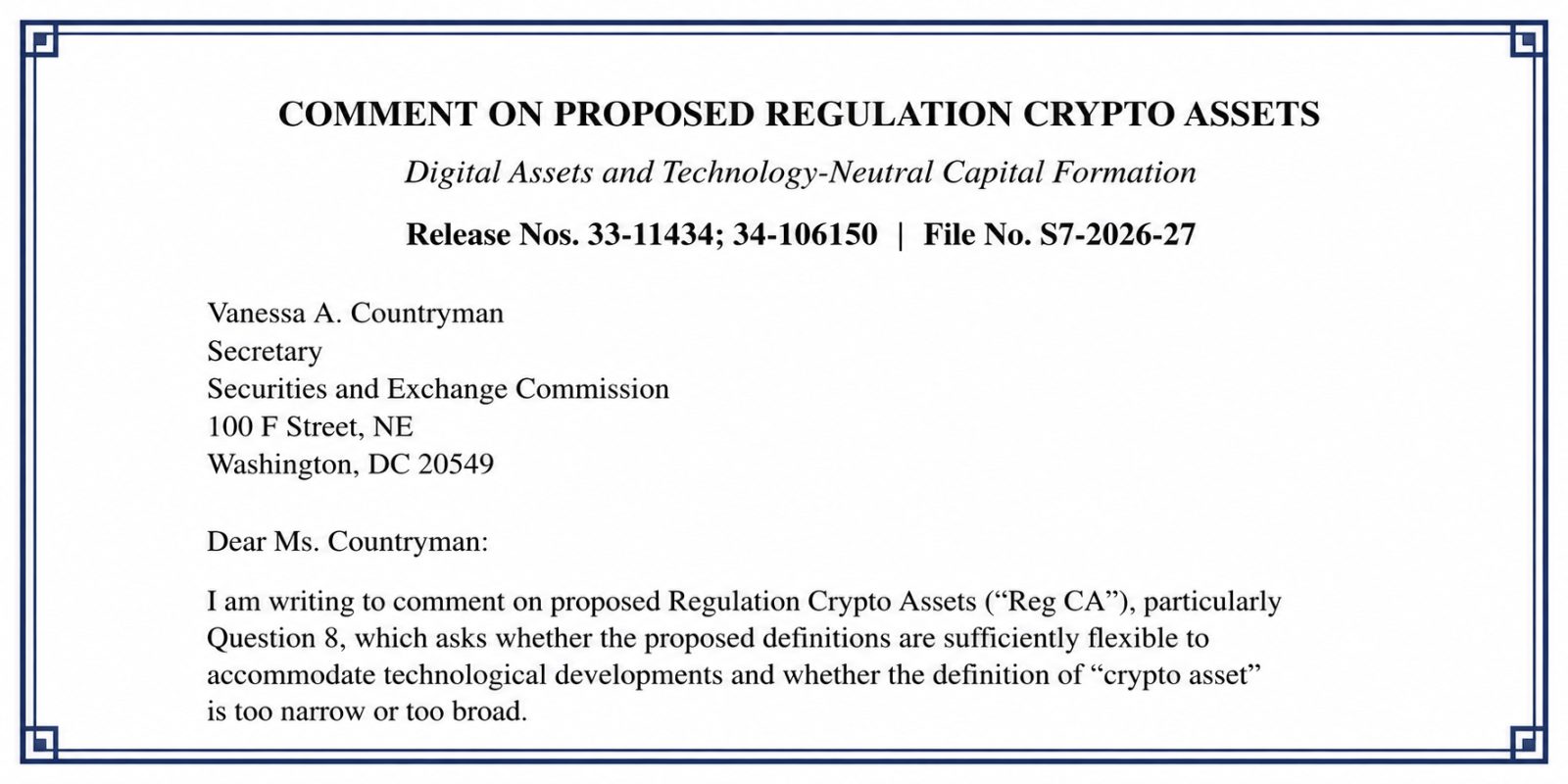
COMMENT ON PROPOSED REGULATION CRYPTO ASSETS
Digital Assets and Technology-Neutral Capital Formation
Release Nos. 33-11434; 34-106150 | File No. S7-2026-27
Vanessa A. Countryman
Secretary
Securities and Exchange Commission
100 F Street, NE
Washington, DC 20549
Dear Ms. Countryman:
I am writing to comment on proposed Regulation Crypto Assets ("Reg CA"), particularly Question 8, which asks whether the proposed definitions are sufficiently flexible to accommodate technological developments and whether the definition of "crypto asset" is too narrow or too broad.
I approach this proposal from the perspective of capital formation and financial innovation rather than as a securities-law practitioner.
I believe Reg CA recognizes an important development in startup finance: companies can raise capital through contracts associated with digital assets that have utility, collectible value, access rights, or other characteristics separate from the investment contract through which they are initially sold.
My concern is that the proposal makes one particular technology - a cryptographically secured distributed ledger ("DLT") - a prerequisite for using the new framework.
I encourage the Commission to consider whether the startup and fundraising exemptions should be available for economically similar digital assets maintained on centralized systems as well.
The Financial Innovation May Be More Important Than the Technology
Many of the basic economic ideas behind today's utility tokens and digital collectibles predate blockchain technology.
Businesses have long sold rights to future products and services, memberships, subscriptions, tickets, licenses, collectibles, and other contractual rights. Property ownership and contractual rights also have long been recorded in centralized registries and ledgers.
What DLT helped change was the practicality of creating standardized digital units that could be readily held and transferred among users. This contributed to the development of markets and liquidity for assets that previously would have been difficult or costly to trade.
As a result, DLT helped reveal a potentially useful financing model.
A startup can create a digital asset that has value or usefulness within the business it is building and sell that asset as part of a capital-raising transaction. The investment contract and the underlying digital asset can be conceptually separated. Reg CA recognizes this distinction.
But once the financing model has been identified, it is worth asking whether DLT must always remain a necessary part of it.
Consider Two Startups
Suppose two startups each want to create 100,000 digital membership units.
The units provide the same access to a future service. They have the same initial price, the same limited supply, and the same transferability. Neither underlying unit is itself a security, although the circumstances of the initial capital raise cause the sale to involve an investment contract.
Startup A records ownership and transfers on a blockchain.
Startup B records ownership and transfers in a conventional database and provides a marketplace through which customers can transfer the units.
If purchasers can readily buy, own, and transfer both assets, the economic differences between them may be much smaller than the technological differences.
Under proposed Reg CA, however, the technological difference is fundamental. Startup A's underlying asset can satisfy the definition of a crypto asset. Startup B's cannot.
That distinction could affect how entrepreneurs design their businesses.
Regulation Should Not Unnecessarily Determine Technology Choices
My principal concern is the incentive this creates.
If Reg CA provides an attractive capital-raising pathway only when the underlying asset uses DLT, a startup that otherwise would use a centralized system may have a regulatory reason to move the asset onto a blockchain.
There may be excellent business reasons to use DLT. In other situations, however, a conventional database may be cheaper, simpler, faster, easier to maintain, or better integrated with the company's product.
Entrepreneurs should ideally make that choice based on the needs of their businesses and customers rather than because one database architecture provides access to a better capital-raising regime.
Requiring DLT can therefore create a real cost even if implementing DLT itself becomes inexpensive. It can cause businesses to organize products and systems around regulatory eligibility rather than operational efficiency.
**Investor Protection Does Not Necessarily Require One Type of Ledger
**
I recognize that a blockchain and a centralized database are not identical.
A public distributed ledger can make information about supply and transactions independently observable. Depending upon its design, it can also constrain an issuer's ability to change records or increase supply.
Those are legitimate considerations.
But securities markets have long operated using centralized recordkeeping systems. Investor protection generally does not depend on every investor having direct access to an immutable public ledger. It also can depend on disclosure, recordkeeping requirements, internal controls, independent intermediaries, audits, attestations, antifraud rules, and regulatory oversight.
Similar protections could be applied to centralized digital assets.
For example, the Commission could require an issuer to disclose who controls the authoritative record, whether the issuer can increase supply or change ownership records, and how transfers are recorded. Where appropriate, outstanding supply and transaction records could be subject to independent verification or periodic attestation.
A centralized system should not automatically be treated as equivalent to a blockchain. But neither should it automatically be excluded simply because it achieves necessary investor protections differently.
The Market May Be Moving Beyond the Technology That Created It
There is a broader reason I believe this question is important.
DLT helped create awareness of utility tokens, digital collectibles, and similar assets. It demonstrated that people may value standardized digital units that combine ownership, utility, access, collectibility, and transferability.
The market now understands those products in a way it did not before the development of crypto markets.
That raises the possibility that some of the economic innovation associated with crypto can exist independently of blockchain technology.
Had DLT never existed, but startups nevertheless developed liquid markets for transferable digital utility units and digital collectibles maintained on centralized ledgers, securities regulators would still have needed to determine how capital raising involving those assets should be treated.
The appropriate regulatory analysis presumably would have focused on the economic relationship between the company, the purchaser, the investment contract, and the underlying asset - not on whether the database happened to be distributed.
The existence of DLT should not prevent the Commission from asking the same question today.
**A Narrow Alternative Would Be Preferable to Broadening "Crypto Asset"
**
I am not suggesting that the Commission redefine every electronically recorded right as a "crypto asset."
That would be far too broad and could encompass ordinary securities and countless conventional commercial arrangements.
Nor do I believe the Commission needs to abandon the proposed DLT-based framework.
Instead, I encourage the Commission to consider whether the Subpart B startup exemption and Subpart C fundraising exemption could include a narrowly defined alternative for non-security digital assets that have characteristics similar to the utility tokens, digital collectibles, and other digital assets contemplated by Reg CA but are maintained using centralized technology.
Such an alternative could require appropriate disclosure and verification of matters such as:
• the total number of units outstanding;
• how additional units can be created or existing units destroyed;
• who maintains the authoritative ownership record;
• how ownership and transfers are recorded;
• whether and how the issuer can alter those records;
• whether the issuer can restrict transfers or revoke units; and
• what independent verification, audit, or attestation procedures apply.
These requirements would allow the Commission to address the actual differences between centralized and distributed systems without requiring every company to solve the same problems using the same technology.
Avoid Making DLT a Regulatory Toll
Reg CA has the potential to make an important contribution to startup capital formation.
One unintended consequence, however, could be to make DLT a regulatory toll that a company must pay to participate in a useful new financing model.
That would be unfortunate.
DLT should be used when its characteristics make it the best technology for a product. A centralized ledger should be used when its characteristics make it the better technology. Securities regulation should establish the investor protections required for the financing transaction without unnecessarily determining that technological choice.
I therefore encourage the Commission, particularly in considering Question 8, to examine whether the startup and fundraising exemptions can be made technology-neutral while remaining economically and functionally narrow.
The question is not whether a blockchain and a centralized database are technologically equivalent. They are not.
The question is whether the benefits of the capital-formation model recognized by Reg CA should be permanently tied to the particular technology that helped bring that model into existence.
I believe allowing room for alternative technologies, subject to appropriate investor protections, would make the proposed framework more durable, reduce unnecessary costs for startups, and encourage continued innovation in both financial products and the technologies used to deliver them.
Respectfully submitted,
Shane Hadden
Globefin.org