Global Financial Innovation
A comparative course on how countries design, regulate and reinvent their financial systems — built module by module, specifically for COIL. Each module is self-contained and country-paired, so you can take the whole course or drop a single module into a class you already teach. The University of Kentucky and Universidad Peruana de Ciencias Aplicadas teach it together today. We are looking for the next universities to join us — anywhere in the world.
One classroom, two countries
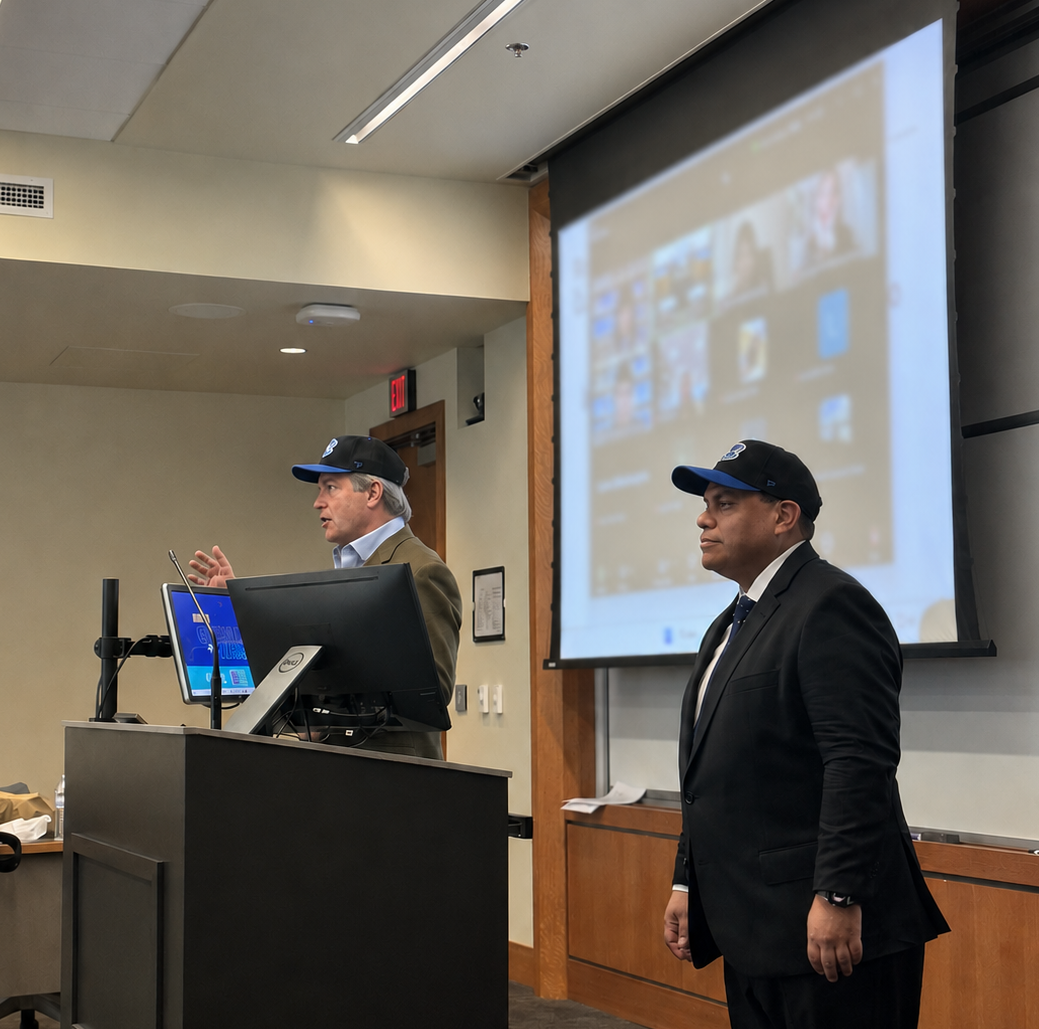
Global Financial Innovation is a comparative course on how societies move money, lend it, pool risk, fund businesses and provide for old age. At UK and UPC it runs as a single shared class: mixed binational teams, the same deadlines, the same four build sprints, with each university teaching and grading its own students.
It is delivered as self-contained modules. A partner class can take the full sequence, or run a single module jointly for one week and keep the rest of its own syllabus untouched.
One course, taught simultaneously on two continents, with students in the same teams from week one.
Collaborative Online International Learning — two universities in two countries teaching one course together, online, as part of a normal term. Students are placed in mixed teams across both campuses and work together on shared assignments and deadlines.
It is not a study-abroad trip, an exchange programme or a guest lecture. Nobody travels and nobody pays a fee. Each university enrols its own students, teaches on its own calendar and awards its own grades — what is shared is the classroom, the teams and the work. For most students it is the only genuinely international project they will do during a degree, and it costs their institution nothing to offer.
Every week the class reads the same numbered module for both countries — module 05 is Payments in both, module 09 is how each provides for old age — and then discusses it with somebody who has lived inside the other answer. Half the room always knows something the other half is only reading about. That is the entire engine, and it is not something either university could build alone.
Then teams build. Four times a term they design a financial product for a real market and defend it against classmates playing the incumbent firm, the regulator and the customer who has already declined. The sprints alternate which country they anchor in, so every student spends part of the term as the local expert and part of it as the newcomer.
The whole delivery is published. Every session, every reading, every workshop document and every rubric from the Kentucky–UPC class — read it before you decide.
See the Lexington–Lima class → Talk to us →Eleven learning outcomes, and what each week is building toward
The clearest short description of the course we can give you. Every module and every build sprint serves one or more of these, and the published delivery carries an outcome map marked primary or reinforced — so if your programme needs a crosswalk, it is already written. They hold whichever modules you take.
Explain how economic, historical, and cultural factors influence the design of financial services around the world.
Compare and contrast financial products, institutions, and regulations across countries.
Identify and describe major forms of financial innovation and financial technology in banking, lending, payments, insurance, and investments.
Analyze how values and public policy choices shape financial inclusion, consumer protection, and access to credit in different countries.
Evaluate the benefits, risks, and unintended consequences of financial innovation in a global context.
Apply comparative reasoning to assess why similar financial problems are solved differently across countries.
Interpret real-world examples of global fintech firms, financial reforms, or regulatory approaches using course concepts.
Communicate clearly, in writing and discussion, about global financial systems and innovation using appropriate terminology and evidence.
Navigate the discussions and tensions around citizenship in a globalizing and interconnected society.
Evaluate how structures or institutions intersect with global trends and dynamics considering local cultural, social, political, financial, economic and other factors.
Demonstrate ethical approaches to resolving individual and collective decision-making in a globalizing and interconnected society.
The heart of every module
A module is reading plus a build sprint, and the sprint is where the learning happens. Teams design a financial product for a real market and defend it against classmates playing the incumbent, the regulator and the customer. Each one is a country paired with a product. These are built and tested:
Payments
A dominant wallet already has most of the country. Find the customer it structurally cannot serve.
Read the case pack → 🔒 PeruPensions
Individual retirement accounts, repeatedly opened early. Design for a saver who has seen the rules change.
🔒 Sign in to read → 🔒 United StatesInsurance
Cover somebody the market prices out — and answer to a carrier and a state regulator.
🔒 Sign in to read → 🔒 MaliBanking
Currency, licence and rails all set elsewhere. Choose which dependency you accept.
🔒 Sign in to read → 🔒 MoroccoSharia
A sector serving a near-universal commitment. Attack the funding side, not the product side.
🔒 Sign in to read → 🔒 MoroccoCredit
A workshop with no collateral and no readable accounts. Three moves are available; pick one.
🔒 Sign in to read → 🔒 MoroccoCash
The rails work and the shopkeeper still says no. Find the party whose interest pays for him.
🔒 Sign in to read → 🔒 MoroccoInclusion
No employer, no payslip. Get two mechanisms right: how she pays, and how she claims.
🔒 Sign in to read →Peru · Payments is open to everyone — read the whole case pack without an account. The rest open with a free account, and facilitator guides are available to instructors: run of show, the lines to say out loud, failure modes, and the answer key for every direction a team can take.
Request instructor access →The workshop guide is the one document that governs all of them — the rules, the four roles, block-by-block timing, what students hand in and when, and the rubric they are marked against. Read it once and every sprint runs the same way.
🔒 Open the workshop guide →Every country, the same thirteen modules
Each country track runs the same numbered modules in the same order — banking, payments, credit, insurance, capital markets, pensions, inclusion, fintech. That numbering is what makes a pairing work: module 05 is Payments everywhere, so two classes assign the same number and the comparison writes itself. Every module is a self-contained read with worked examples and a self-quiz. The whole Peru track is open — read all thirteen modules without an account. The rest open with a free account.
Your country is not on this list? Tell us where you teach and who you would like to pair with. The tracks sit on a fixed skeleton, so building one is a known job rather than an open-ended research project — and it is the part we are glad to do.
Ask for your country →How a module is assembled
A module is one country lesson, one workshop, and the guide that runs it. That is the unit — take one, take four, or take the sequence.
Both classes read the same module number
You assign your country’s module 05; your partner assigns theirs. Same topic, same depth, same week. Neither of you researches the other’s country.
The paired workshop anchors in one of them
Peru · Payments anchors in Peru. The cohort that lives there can go and ask people; the other does the research and holds the adversarial roles — then it alternates.
The guide runs the room
Same rules, same four roles, same rubric, on both campuses, from the same document. It is what lets two instructors teach one session without rehearsing it together.
Stack them, or do not
One module is a week. Four make a joint unit with an escalating sequence of problems. The full set is the course. Nothing breaks if you stop at one.
Working with students on the other side of the world
Not a guest lecture, not a video exchange, not a pen-pal week bolted onto a normal course. Shared teams, shared deadlines, and a genuine disagreement to resolve with somebody whose everyday experience contradicts theirs.
They understand their own country better
You cannot see the assumptions inside the system you grew up in until somebody who grew up in a different one asks why it works that way. Every student gets that, because every student is the newcomer half the time.
They build real things and defend them
Four times a term, teams design a financial product and take hard questions about price, licensing and who carries the risk. No entrepreneurship background needed — the method is taught from zero and repeated until it is theirs.
They can read any system, not just two
The module structure is a method, not just a syllabus. A student who has worked through two countries can pick up a third and know what to look for — a durable skill in careers that will cross more borders than ours did.
It is the thing they talk about in interviews
“I designed a payments product with a team in another country and presented it to people who told me why it would not work.” For many, the first genuinely international work they can describe concretely.
They learn to reason from evidence
Every claim needs a source or an honest flag that it is a guess. “I could not find this number, and here is where I looked” scores above inventing one — a rule students carry into everything else they write.
The ethics arrive on their own
Inclusion, consumer protection, privacy, who a system leaves out — not a bolted-on week. They turn up the moment two countries answered the same question differently.
What is supplied, and what you bring
Two universities coordinate far less than people expect. Each keeps its own calendar, its own credit hours, its own admission standards and its own grading scale. What is shared is the reading map, the four sprint weeks, and the deadlines inside them.
| Supplied | You bring |
|---|---|
| An introduction to a university already teaching it, and help agreeing a shared calendar | Approval at your end, and one workable hour of weekly overlap. |
| Country tracks for both sides of the pairing — built if they do not exist yet | Your country, and any local sources or contacts you would like the track to reflect. |
| A 31-session schedule mapped module by module and tiered into pre-class and optional | The decision about what to cut or change for your term length. |
| Eight sprint packs with facilitator guides, run-of-show and answer keys | The facilities, technology support, LMS - shared LMS may be possible. |
| Rubrics, role briefs, rotation tables and a mapped outcome set | Your own grade weights, your institution's scale, and other university specific details . |
Five steps, and the first one is an email
Nothing commits you before you have seen the materials and met the person you would be teaching alongside.
Tell us where you teach
Your university, country, term dates, rough cohort size, and the hours you could meet a partner. One message is enough →
Meet a class already running
We introduce you to an instructor whose calendar fits yours — starting with the Kentucky and UPC pairing, which has been through the whole cycle and knows where the friction is.
We build the country tracks you need
If your country is not published yet, this is where it gets written — on the same skeleton, to the same standard, openly licensed like everything else.
Agree the shared weeks
Only the four sprint weeks need to be simultaneous. Everything else runs independently on each campus, which is what makes mismatched calendars workable.
Teach it, then publish it
Your delivery goes up here beside the others, credited to you and your partner, so the next pair of universities starts from your work rather than from nothing.
Or start with one sprint
Run a single build sprint with a partner class as a two-week unit inside a course you already teach. Several partnerships are easiest to begin this way.
Not sure yet? Ask for instructor access and read a facilitator guide. It is the fastest way to tell whether this is a course you want to teach.
Request access →The things instructors ask first
Do we have to teach the whole course?
No. It is modular. The smallest useful unit is one module — a single week run jointly with a partner class, inside a course you already teach and otherwise keep exactly as it is. Add more later if it worked.
Is it ready to teach, or will we be adapting it?
Ready. Take a module and its workshop as published and it works — that is why the facilitator guides exist. But tell us what you need changed and we will build it with you: a case reset in a market your students know, a sprint compressed into one session, readings re-cut for a different level. No charge.
Does the course rank countries?
No, and it is designed not to. No system is the standard the others are measured against. Every one is presented as serious answers built under real constraints, and the question is always why this answer here.
My country is not one of the eleven. Can we still do this?
Yes, and we would like you to. The eleven published tracks are where we have reached, not a boundary. Tell us your country and your partner's and we build both, on the same thirteen-module skeleton, to the same standard.
Do I have to find my own partner?
No — that is the part we most want to help with. Tell us your term dates, cohort size and workable hours and we look for a match. If nothing fits your term yet we will say so rather than leave you waiting.
Our academic calendars will not line up.
Kentucky's and UPC's do not either. Only the four sprint weeks need to be simultaneous — eight or nine shared sessions in total. The reading runs independently on each campus at whatever pace suits your term.
How do two universities grade one course?
They do not. Deliverables and deadlines are shared; each university grades its own students on its own scale, which matters where scales differ — as between a US letter grade and a Peruvian 0–20.
What about the time difference?
You need one workable hour of overlap for the sprint sessions. Everything a student submits is individual and posted to a shared folder, so no one's mark depends on a teammate being awake — a design decision made specifically for this.
What language is it taught in?
The materials are in English today. The Kentucky–UPC pairing lets teams work in Spanish inside their own breakout and translate only the sentence they report — a device that transfers to any pairing. Translations are welcome under the licence and we would like to host them.
What level is it?
Business undergraduates, upper-division. No prerequisite beyond an introductory finance or economics course. The sprints assume no prior entrepreneurship exposure — they teach the method from zero and repeat it four times.
How large a class?
The binding constraint is the pitch round: four teams fit a session comfortably, which is about 16–25 students per section on each side. Larger cohorts use parallel pitch rooms, and the facilitator guides explain how.
I have never taught a build sprint.
The facilitator guides exist for exactly that: run of show block by block, the lines to say out loud, the failure modes with fixes, a model answer for every direction a team can take, and contingencies for when the room is not the room you planned for.
What does it cost, and can I change it?
Nothing, in any currency. Content is CC BY 4.0 — adapt it, re-cut it, translate it, use it commercially, with attribution. Students need a free account to read the modules. There is nothing to procure at either university.
Can we start with something smaller than a whole term?
Yes. A single build sprint runs as a two-week unit between two classes that are otherwise doing their own thing. It is a low-risk way to find out whether the partnership works before either of you rebuilds a syllabus.
How do I get the facilitator guides?
Case packs, schedules and rubrics are open to any member. The facilitator guides are instructor-only because they carry the answer keys. Tell us you are teaching and we will flag your account — no charge, no ordeal.
Two dots today. This is where it goes.
Because every university is teaching the same modules, every one of them can pair with every other. Three partners make three pairings; six make fifteen. Each new university multiplies what is available to everyone already teaching it — which is why we would rather recruit you than simply hand you a folder.
Where this is going: every university paired with several others, not just one. Each dot has four partners.
A pairing works between any two countries. Eleven country tracks are published today — Peru, the United States, Kenya, Mali, India, China, Morocco, France, Spain, Türkiye and Brazil — and that is where we have reached, not where this stops. More are in build, and which ones get built is decided by which universities come forward.
So if you teach somewhere that is not on that list, you are not on the wrong page. Tell us your country and your partner's, and we build the tracks the pairing needs — on the same thirteen-module skeleton, to the same standard, published openly like everything else. It is a known and bounded piece of work, and it is the part we are glad to do.
There is a class already running. Come and join it.
Students in Lexington and Lima are in the same teams this term, working through how two countries decided to move money, lend it and provide for old age. We would like students in your country in that conversation — and the curriculum, the sprints, the rubrics and the guides are all built, published and already tested on real students. Tell us where you teach, and we will take it from there.